


 US
site
US
site
 UK
site
UK
site
 AU site
 EU
site
EU
site


If you've ever asked yourself how to improve vocabulary for your child, the good news is that it can be a lot more fun than it sounds. Big words open big doors, and kids who grow their vocabulary gain a huge boost in reading, writing, and everyday confidence.
The earlier they start, the easier it is to soak up new words and actually enjoy using them. We're going to explore why vocabulary matters so much, how reading naturally builds it, and the most effective tricks to help your child turn tricky words into familiar friends.
What this article covers:
- Why Is It Important to Improve Vocabulary Early?
- How Does Reading Improve Vocabulary So Well?
- How to Build Your Child's Vocabulary
- Conclusion
Why Is It Important to Improve Vocabulary Early?
When kids know more words, they can read with less guesswork and more joy. Sentences stop being puzzles and start being adventures. Strong vocabulary development for children turns reading into something that feels smooth and satisfying.
It also gives children sharper tools to express themselves. Instead of saying “I'm mad,” they can say “I'm furious,” “I'm annoyed,” or “I'm frustrated.” Those differences matter. They help kids explain exactly how they feel or what they think. And let's be honest, it feels pretty great when a child uses a grown-up word with total confidence.
The impact shows up early. Researchers have found that vocabulary size by age 4 can predict later school success. That means every story read together, every conversation, every new word noticed makes a real difference.
Kids who know the words in a tricky sentence don't get stuck. They keep moving, understand the idea, and build on it. Those little wins stack up, leading to stronger readers, clearer writers, and more confident learners.

How Does Reading Improve Vocabulary So Well?
Reading is one of the richest ways for kids to collect new words. Every book, comic, or article offers vocabulary they're unlikely to hear in everyday conversation. And because words appear in full sentences and real situations, kids get natural clues about meaning.
Context does the heavy lifting here. If a passage says, “The mountain path was treacherous, and the hikers slipped on the ice,” kids can figure out what treacherous means without anyone spelling it out. The more times they encounter the word in different settings, the stronger it sticks in memory.
The variety of reading also matters. Stories expand emotional vocabulary with words like reluctant or elated. Nonfiction introduces subject-specific terms like photosynthesis or archaeologist. Poetry adds flavor with playful and surprising word choices. Each type of reading grows a new slice of vocabulary knowledge.
Best of all, kids are naturally curious when a story hooks them. They'll pause and ask, “What's that word?” in a way they wouldn't during a drill. That spark of curiosity makes reading the ultimate playground for vocabulary growth.
It works, conversely, too. Improving your child's vocabulary through reading is one of the best ways to improve reading comprehension in the long run, especially by using Reading Comprehension Worksheets.

How to Build Your Child's Vocabulary
Here's where we get hands-on. These word learning strategies for children are ones we've used and refined through years of making reading and writing workbooks and observing real learners. Here's how to help your child learn new words:
1. Model Curiosity and Word Noticing
Show curiosity out loud. When a new word pops up, say, “Let's check it.” Wonder together about meaning, pronunciation, and part of speech. Try the context first. Then peek at word parts and a child-friendly dictionary.
Keep sticky notes handy for “words we're watching.” Add tricky words to a small jar and pull one at dinner. Use it in a sentence and high-five the attempt. Compare it with a simpler synonym to show shades of meaning.
Circle back the next day and ask for a quick recap. When we model the process, kids copy the habit. That's how noticing turns into skill.
2. Use Interactive Read-Alouds and Talk About Words
Preselect three juicy words before you read. Say them clearly. Invite predictions. During the story, pause briefly when each word appears and think aloud: “What helps us here?” Point to surrounding clues. Ask, “What would be another way to say this?” Keep it snappy so the story flows.
After reading, return to the words for a 60-second chat. Try a quick “turn and explain” to a stuffed animal or sibling. Finish with one oral sentence per word. Put those sentences on a whiteboard and revisit them tomorrow. Read-alouds become language labs when we plan tiny moments of focused talk.

3. Introduce Word Parts (Roots, Prefixes, Suffixes)
Teach a few high-impact pieces at a time. Start with un, re, pre, mis, and the suffixes ful, less, and able. Add roots like bio, geo, tele, and micro. Build word sums together: un + happy, re + write, bio + graph.
Say them, spell them, and test meaning quickly. Sort cards into families to show patterns. Create an anchor chart of “power parts” on the fridge.
When a new word appears, ask, “What pieces do we see?” Kids learn to crack words open and predict meaning. Short, frequent practice with Spelling Worksheets works best. Five minutes a day beats one long lesson.
4. Provide Multiple Exposures in Different Contexts
Plan for the repeat. Introduce a word in a book tonight. Use it in conversation tomorrow. Prompt for it in writing later in the week. Give mini-challenges like “three times today.” Swap in a synonym at breakfast and an antonym at bedtime. Add the word to a fridge list and nudge a quick sentence before school.
Revisit after a few days for spaced practice. Ask for a kid-friendly definition and one personal example. Keep the tone light. Small, frequent touches beat marathon drills. When a word shows up across settings, meaning firms up, and recall becomes easy. This is one of the best ways to improve writing and vocabulary.

5. Use Games and Playful Activities
One of the best ways to expand your child's vocabulary is to make vocabulary a quick game, not a slog. Try one-minute charades for new verbs. Play Pictionary with adjectives. Do a lightning round of “Say it in a sentence.” Create a mini bingo card with words of the week. Hide word cards around the room for a speedy scavenger hunt. Set a five-minute timer and rack up points for correct usage. Winners pick tomorrow's read-aloud or the snack.
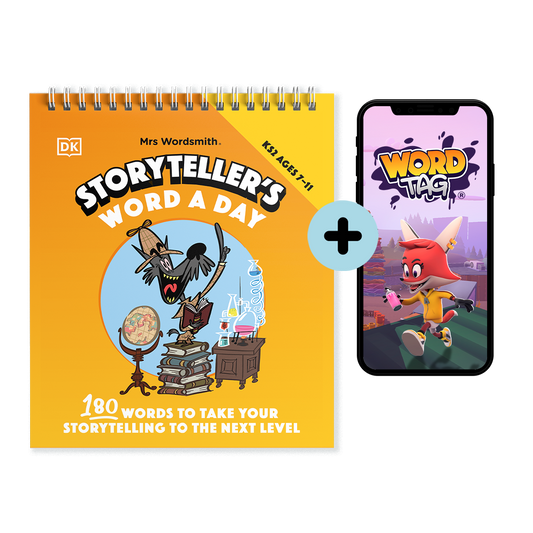
For ready-to-go fun, check out Mrs Wordsmith's Vocabulary Worksheets. Books like our Storyteller's Word a Day and My Epic Life Daily Word Workout are designed to feel like games, so kids stay engaged while actually learning. Short, lively bursts keep motivation high and make practice something kids look forward to.
6. Keep a Vocabulary Journal or Notebook
Give the notebook a simple structure. One page per word. Include the word, pronunciation, part of speech, a kid-friendly definition, one original sentence, and a quick sketch. Add a synonym or antonym when possible. Date each entry to track growth. Use tabs for categories like science, feelings, or school. Digital works too if your child prefers typing.
Review on Fridays with a two-minute flip-through. Star words used correctly during the week. On Sundays, pick two starred words for a “spotlight sentence.” The journal becomes a record of progress and a reference kids can actually use.
7. Use New Words in Speaking and Writing
Put words to work. At dinner, toss out a prompt: “Describe your day using meticulous and relief.” Offer sentence starters for shy speakers. Post a small word list near the homework spot. Ask for a two-sentence update note to a grandparent using a target word. Challenge a quick text to a cousin that swaps a plain word for a stronger one.
Praise attempts, not perfection. Gently model if the word lands a bit off. Recycle the same words across the week, then retire them once they feel natural. Usage builds ownership faster than studying alone.

8. Read Widely but With Scaffolding
Balance stretch and comfort. Use the five-finger check to select slightly challenging books. Preview three key words before reading. Give a simple meaning and a quick example. Use sticky tabs to mark pages with meaty vocabulary.
Pause for a ten-second chat when a marked word appears. Pair print with audiobooks for tough texts. Keep a tiny bookmark glossary for names and domain words.
After reading, ask for one sentence that uses a target word. Gradually reduce support as confidence grows. The aim is steady success, not overwhelm. Wide reading works best when support meets the moment.
9. Use a Tiered Vocabulary Approach (Tier 1, Tier 2, Tier 3)
Aim for the sweet spot. Tier 1 words are everyday basics. Tier 3 words are subject-specific. Tier 2 words carry power across subjects and deserve most of our attention. Plan weekly targets that mix two Tier 2 words with one timely Tier 3 from current school topics. Teach meaning with examples and contrasts. Use each word in speech and writing.
Recycle last week's words in this week's prompts. Keep a running list on the fridge so the family can join in. This approach builds flexible language kids can use anywhere while still supporting content learning.

10. Be Patient and Track Progress
Progress takes time. Set simple checkpoints. Can your child explain the word in their own words, use it orally, and write it in a sentence? Create a small tracker with those three boxes per word. Check them off over a week. Do a five-question review every Sunday. Mix old and new words. Celebrate any box checked.
If a word keeps slipping, reteach with a new example and keep going. Every few weeks, look back and highlight five mastered words. Post them proudly. Data should feel friendly and quick. Patience plus steady practice builds durable vocabulary growth.
Conclusion
Strong vocabulary skills help children read with confidence, write with clarity, and express themselves in ways that truly reflect their ideas. The best results come from starting early, reading widely, talking about words, and making practice playful through games and everyday conversations.
It's a steady process, built through curiosity, repetition, and use in real contexts. With the right support, kids don't just learn words, they own them.
Give your child the tools to grow their word power and make learning fun with Mrs Wordsmith's resources today. We've got you covered with everything from vocabulary to handwriting improvement tips.



 https://mrswordsmith.com
Comment
Leave a comment